Coming Up:
Online book study began on Feb.25 and will run Wednesdays, 7pm, through Lent, into the Easter season. The book is called To Love and Serve: Anglican Beliefs and Practices.
Lenten Lunches also began on Wednesday, Feb.25, 12-1pm at Emmaus, SSM. They will be held at the same time, in the same place each Wednesday until (and including) Wed. March 25.
It’s Your Lucky Day Dinner! Friday, March 13 in the Trinity Centre, dinner served at 5:30pm. Just $13 for a pork loin roast dinner with all the fixings and dessert. Plus…a silent auction!! Please email Rev. Susan (susan.montague2@gmail.com) for tickets. We’re only selling 60!
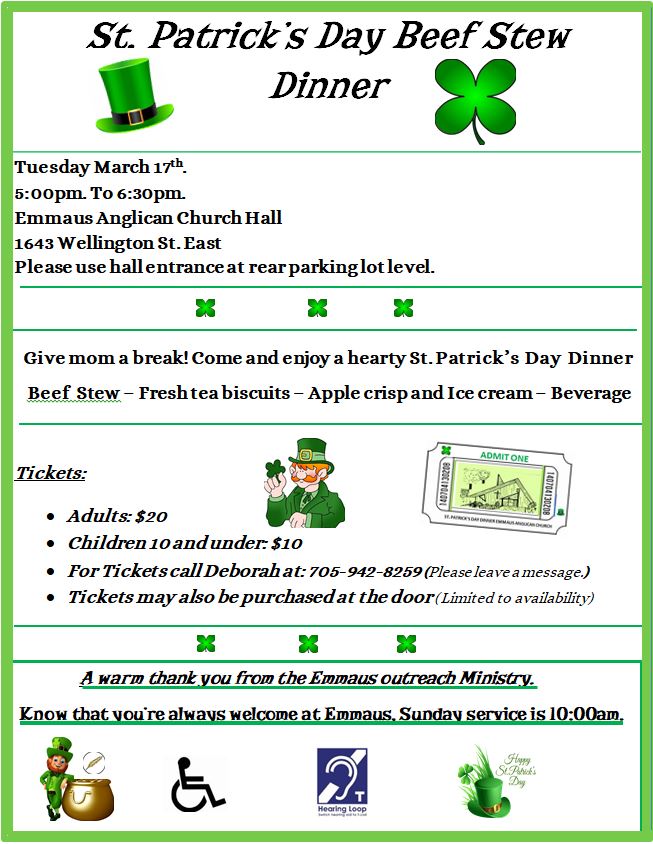
St. Patrick’s Day dinner at Emmaus on March 17. The photo with more information is below.
Movie Night Friday, March 20, 6pm in the Trinity Centre. We’ll be watching “I Can Only Imagine”, $5 entry, free snacks.
A Liturgical Note For You: Palm Waving and Passion Reading
The Sunday of the Passion, with the Liturgy of the Palms: Perhaps you are wondering why we read the Passion Narrative on the Sunday before Good Friday and then we read it again on Good Friday. People who do not know the liturgical history of this practice speculate that perhaps we read the Passion on the Sunday for all of those people who don’t show up to the worship service on the Friday. Nope. This Sunday is named “The Sunday of the Passion, with the Liturgy of the Palms” in order to reflect the fact that the Passion actually dominates the liturgy for this day. The palms may seem to be the main part of the worship since we sing, and process, and wave palm branches around. It is highly recommended that, whenever possible, this part of the service (The Liturgy of the Palms) take place somewhere other than the church itself...perhaps outdoors if weather permits, perhaps in the church hall, or even at the back of the church (if there is room) and then everyone would process to their seats in the church behind the altar party when the Liturgy of the Passion begins.
The Liturgy of the Palms was first introduced by the Jerusalem Church in the late 300’s but the western church did not begin celebrating this liturgy until some time in the 600’s – and they changed it from an evening procession around the city into a morning procession into the church.
Alright, so why the emphasis on the Passion of Christ when this is not the day he died? There is a very long history – many centuries old – to this practice as well. Reading the Passion Narrative on the Sunday beginning Holy Week turns our hearts and minds more fully to the events of the week leading up to Jesus’ death on the cross. The Passion Narrative, as a matter of fact, used to read in churches every single day during Holy Week. Reading the Passion Narrative so quickly on the heels of the triumphant entry into Jerusalem “will not allow any theology that dwells on triumphalism. It will not let us deceive ourselves about the sort of Messiah that Jesus is. To leave Palm Sunday without the Passion narrative can leave one with the impression that Jesus is the conquering Messiah, the Messiah of worldly power. The Passion narrative reminds us that we follow the crucified Messiah, the one who gained victory precisely in defeat” (The Rev. David L. Hansen at thedigitalpastor.org). It is also a reminder that we – the church – are simultaneously the ones who shower Jesus with accolades and then demand his death. We have been made holy by Christ but we still turn from God. Creation is good but broken by sin. The kingdom is here but is not yet fully revealed.
One final point, The Sunday of the Passion rotates through the Gospels of Matthew, Mark, and Luke – never John. The first three Gospels provide the narrative of the Last Supper in which Jesus instructs us to eat his body and to drink his blood, the new covenant, in remembrance of him. Then we hear the rest of the story of Jesus’ betrayal and arrest, his death and his placement in the tomb. John’s account of the crucifixion is always the one read on Good Friday. John shows us how to see Jesus’ death as his glorification. More on this later…
For Your Devotions:
Monday, March 9th is the memorial of Gregory of Nyssa, Bishop, Teacher of the Faith, died about 395. Gregory was one of the three Cappadocian Fathers which also included his brother, Basil the Great, and his friend, Gregory of Nazianzus. Gregory and the others were instrumental in arguing against the Arians (who believed Jesus was a creature subordinate to God and thus, not God). In so doing, they established the place of the Holy Spirit in the Trinity as well. Gregory is well-known for his mystical writings in which he emphasizes that the spiritual life is not one of static perfection but one of constant progress. For more: https://www.britannica.com/biography/Saint-Gregory-of-Nyssa
Tuesday, March 10th is the commemoration of Robert Machray, First Primate of Canada, died 1904. Machray was born in Scotland into a Presbyterian family but chose to become a member of the Church of England in his early adulthood. He gave up a comfortable, secure income and position in the church to become the new bishop of Rupert’s Land in Canada. (At 34 years of age, he was the youngest bishop). At that time, Rupert’s Land was huge and it was Machray who arranged to have it divided into smaller dioceses…Moosonee, Athabasca, and Rupert’s Land. Machray was bishop throughout the tumultuous period of the Metis uprising and our confederation. Some feel that Machray’s strong opposition to the uprising was highly controversial. It was Machray who instituted the elected vestry and it was also Machray (and others) who introduced the notion of a general synod to Canada in order to coordinate church resources and speak with one voice. Appropriately, at the first general synod in 1893, he was chosen to be Canada’s first primate. To read more: http://www.biographi.ca/en/bio/machray_robert_13E.html
In the hope of Christ,
Susan
 Deanery of Algoma